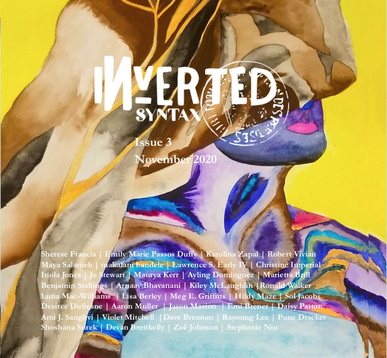
 Inverted Syntax Issue 3 | November 2020 Cover Art "Earth-like" by Violet Mitchell Dear Reader,
We hope you are staying safe and finding ways to replenish your spirits. Here at Inverted Syntax we have been busy in continuing to work towards addressing our publishing practices. We wanted to send a progress report in September but we got caught up preparing our print Issue 3 for you, which by the way is now available for preorder. Before we get to our practices, here's a quick peek into Issue 3. In this print issue, we bring to you, dear reader, the embodied and disembodied, the self and absence of self: self as a place, as a thing, as the missing, as a life, as the dead. When we were accepting pieces for publication we must have been connecting with those themes because we found ourselves shocked by the number of narratives that centered around grief, self, and language. It was clear that we wanted to bring them together because we wanted to be whole, because all the topics, from grief, to sex, to language were the disembodied self seeking a way to make itself whole again. We saw ourselves, the editorial team, in these pieces, and we leaned into each, bringing with us our own sadness and joys, despair and hopes. It almost feels as though we created Issue 3 as therapy; as a community space to find solace in our shared joys and suffering; to be a space for readers to find comfort in the shared grieving, in the experience of losing ourselves, or being robbed of our selves. As in past issues, Issue 3 speaks to our deepest subconscious desires about our mortality. We ask you to embrace this issue as a story you wrote — enter it and discover art as a map to the subconscious at work in your life. You’ll find that it is already in conversation with you, before you even open its pages, it connects you to an alternate space, where you will discover that you are not only reading this book, you are also in it — your voice, too, has been woven in and become the text and art. I have said before that putting an issue together is about building a language for our readers — a way in which we seek to be understood, and it starts with the narrative. In my work as an editor of Inverted Syntax I know we are telling a story through the words, works, and people we choose to publish, and we here at Inverted Syntax have been actively seeking ways to revise and create a more inclusive narrative, reflective of many diverse voices and reflective of who we are as a literary magazine. Inverted Syntax's editorial board discovered that in 2020 we looked for submissions that were about more than just resisting conformity and complacency in style or form. More than anything, this year we sought work that turned us inside out and revealed something profound and often menacing about our shared human experience. The murders and continued lynching of Black and Brown bodies have left us in revolt, feeling angered, raw, and at times, helpless and at a loss. In response, we decided this summer to begin bringing forth the change we wish to see in public by reviewing our own private actions, habits, and practices, and we shared with you our goals for improving our publishing practices in particular. Our primary goal at the start of this summer was to do our part to actively tear at the vestiges of racism that permeates all aspects of society and end up seeping into our veins to become our implicit biases. As editor, I saw it as my role to begin an open discussion with the editorial team to find new ways to better attract writers from diverse backgrounds. I am conscious of my responsibility in this role — along with the editorial team and advisory board, and our writers, readers, and publishers — to take action in dismantling the systems of oppression by addressing the ways in which we have held implicit biases, and as a result, been complicit in these systems of oppression. I put forth an examination of our publishing practices so all facets of our literary magazine mirror not only our humanity, but also our values as those who vehemently oppose racism and desire racial equity, and as those who seek to actively support ways to eradicate all traces of discrimination that persist and suppress human beings. I have been regularly asking my team questions about our publishing practices so as to hold ourselves accountable in the role we have played and in the spaces we have made and not made for Black, Indigenous, and all artists and writers of color. We have since taken actionable steps to help us reform our publishing practices:
Currently, the publishing industry does not publish enough positive stories for young people about people of color by people of color. As a trained educator, I am aware that in early learning years, people can only continue to select and teach and introduce what the publishing industry continues to offer them: a limited shelf of books, all of which are of a single story. At Inverted Syntax, we want to take steps towards rectifying that. We have contemplated pursuing new ventures, like publishing chapbooks starting in 2022; however, we feel that if we want to do our part in effecting change in the publishing industry, we must target the specific places in which that change needs to happen. We will continue to report on our efforts. With that, we are eager to present to you Inverted Syntax print Issue 3. We hope you enjoy it as much as we did reading, curating, editing, and assembling it. We hope it means as much to you as it does to us. Stay safe and take care of yourselves. Until next time, with love, Nawal Nader-French Special thanks to Editors, Yesica Mirambeaux and Jesica Davis for their help in editing this letter.
0 Comments
|
Archives
October 2023
Categories
All
|
- Submission Guidelines
- The Fissured Tongue Series
- Sublingua Results
- Store
-
The Art of the Postcard
- About The Art of the Postcard
- Art of the Postcard Issue 3
- Art of the Postcard Issue 2
- Art of the Postcard Issue 1
-
We Are All Artists Exhibit
>
- Video Compilation FirehouseArt Center Postcard Exhibit
-
Firehouse Exhibitors 2022
>
- Churnage FirehouseArt Center Postcard Exhibit
- Daniel Staub Weinberg Firehouse Art Center Postcard Exhibit
- Genevieve Rose Barr Art Center Postcard Exhibit
- Eva Schultz Firehouse Art Center Postcard Exhibit
- Samantha Malay Firehouse Art Center Postcard Exhibit
- D Allen Firehouse Art Center Postcard Exhibit
- Hayley Harris Firehouse Art Center Postcard Exhibit
- Tony Peyser Firehouse Art Center Postcard Exhibit
- Sarah Santoni Firehouse Art Center Postcard Exhibit
- Julia Klatt Singer Firehouse Art Center Postcard Exhibit
- Kathryn Kruse Firehouse Art Center Postcard Exhibit
- Meg Freer Firehouse Art Center Postcard Exhibit
- Moira Walsh Firehouse Art Center Postcard Exhibit
- Stephanie Staab Firehouse Art Center Postcard Exhibit
- Anne Swannell Firehouse Art Center Postcard Exhibit
- Laura Knott Firehouse Art Center Postcard Exhibit
- Jo Goren Firehouse Art Center Postcard Exhibit
- CR Resetarits Firehouse Art Center Postcard Exhibit
- Sarah Ernestine Firehouse Art Center Postcard Exhibit
- Stephanie Johnson Firehouse Art Center Postcard Exhibit
- Charles J. March III Firehouse Art Center Postcard Exhibit
- Emily Mosley Firehouse Art Center Postcard Exhibit
- Grace Desmarais Firehouse Art Center Postcard Exhibit
- Emily Vieweg Firehouse Art Center Postcard Exhibit
- Claire Lawrence Firehouse Art Center Postcard Exhibit
- Meca'Ayo Cole Firehouse Art Center Postcard Exhibit
- Andrea Rexilius Firehouse Art Center Postcard Exhibit
- Christian Garduno Firehouse Art Center Postcard Exhibit
- Salma Ahmad Caller Firehouse Art Center Postcard Exhibit
- Glenn Thomas Firehouse Art Center Postcard Exhibit
- Claire Yspol Firehouse Art Center Postcard Exhibit
- Michael Thompson Firehouse Art Center Postcard Exhibit
- Rikki Santer Firehouse Art Center Postcard Exhibit
- Laura Gamache Firehouse Art Center Postcard Exhibit
- Christine Williams Firehouse Art Center Postcard Exhibit
- Stephanie Beechem Firehouse Art Center Postcard Exhibit
- Imma Dunach Firehouse Art Center Postcard Exhibit
- Ginny Short Firehouse Art Center Postcard Exhibit
- Josh Lefkowitz Firehouse Art Center Postcard Exhibit
- Carolyn Adams Firehouse Art Center Postcard Exhibit
- We Are All Artists Exhibit Guide
- We are All Artists Submission Form Firehouse Art Center Postcard Exhibit
- Nominations & Awards
- About Us
- Submission Guidelines
- The Fissured Tongue Series
- Sublingua Results
- Store
-
The Art of the Postcard
- About The Art of the Postcard
- Art of the Postcard Issue 3
- Art of the Postcard Issue 2
- Art of the Postcard Issue 1
-
We Are All Artists Exhibit
>
- Video Compilation FirehouseArt Center Postcard Exhibit
-
Firehouse Exhibitors 2022
>
- Churnage FirehouseArt Center Postcard Exhibit
- Daniel Staub Weinberg Firehouse Art Center Postcard Exhibit
- Genevieve Rose Barr Art Center Postcard Exhibit
- Eva Schultz Firehouse Art Center Postcard Exhibit
- Samantha Malay Firehouse Art Center Postcard Exhibit
- D Allen Firehouse Art Center Postcard Exhibit
- Hayley Harris Firehouse Art Center Postcard Exhibit
- Tony Peyser Firehouse Art Center Postcard Exhibit
- Sarah Santoni Firehouse Art Center Postcard Exhibit
- Julia Klatt Singer Firehouse Art Center Postcard Exhibit
- Kathryn Kruse Firehouse Art Center Postcard Exhibit
- Meg Freer Firehouse Art Center Postcard Exhibit
- Moira Walsh Firehouse Art Center Postcard Exhibit
- Stephanie Staab Firehouse Art Center Postcard Exhibit
- Anne Swannell Firehouse Art Center Postcard Exhibit
- Laura Knott Firehouse Art Center Postcard Exhibit
- Jo Goren Firehouse Art Center Postcard Exhibit
- CR Resetarits Firehouse Art Center Postcard Exhibit
- Sarah Ernestine Firehouse Art Center Postcard Exhibit
- Stephanie Johnson Firehouse Art Center Postcard Exhibit
- Charles J. March III Firehouse Art Center Postcard Exhibit
- Emily Mosley Firehouse Art Center Postcard Exhibit
- Grace Desmarais Firehouse Art Center Postcard Exhibit
- Emily Vieweg Firehouse Art Center Postcard Exhibit
- Claire Lawrence Firehouse Art Center Postcard Exhibit
- Meca'Ayo Cole Firehouse Art Center Postcard Exhibit
- Andrea Rexilius Firehouse Art Center Postcard Exhibit
- Christian Garduno Firehouse Art Center Postcard Exhibit
- Salma Ahmad Caller Firehouse Art Center Postcard Exhibit
- Glenn Thomas Firehouse Art Center Postcard Exhibit
- Claire Yspol Firehouse Art Center Postcard Exhibit
- Michael Thompson Firehouse Art Center Postcard Exhibit
- Rikki Santer Firehouse Art Center Postcard Exhibit
- Laura Gamache Firehouse Art Center Postcard Exhibit
- Christine Williams Firehouse Art Center Postcard Exhibit
- Stephanie Beechem Firehouse Art Center Postcard Exhibit
- Imma Dunach Firehouse Art Center Postcard Exhibit
- Ginny Short Firehouse Art Center Postcard Exhibit
- Josh Lefkowitz Firehouse Art Center Postcard Exhibit
- Carolyn Adams Firehouse Art Center Postcard Exhibit
- We Are All Artists Exhibit Guide
- We are All Artists Submission Form Firehouse Art Center Postcard Exhibit
- Nominations & Awards
- About Us
 RSS Feed